How?
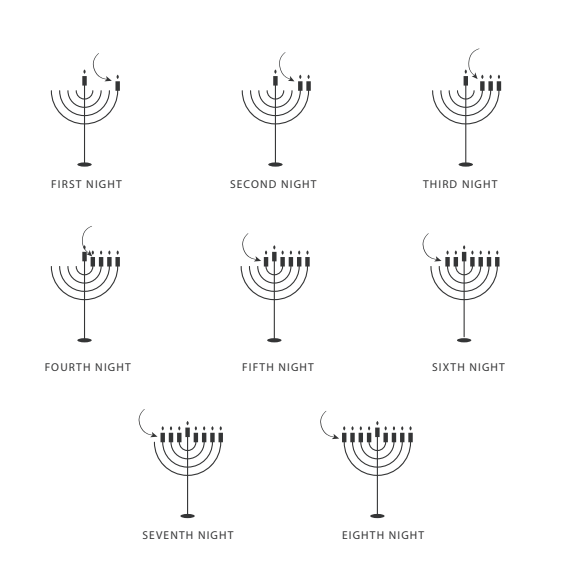
On the first night of Chanukah, one candle is lit. Each night after that, one candle is added to the menorah so that by the eighth night, eight candles are lit.
The prevalent custom is to prepare the candles and oil from right to left, but to light them from left to right. On the first night, light the one on the right. On the second night add one to the left, and light that one first, followed by the one on the right. Each night of Chanukah, add a new one to the left and light that one first, continuing left to right. The menorah should not be moved after it has been lit.
If the menorah was lit properly but went out, it is preferable to relight it, but you are not required to do so. Once it is past the requisite half hour, there is no need to relight it. If you are staying at someone’s house, you light your own menorah, or give the owner a small amount of money, to “own” part of the candles or oil. But if you are just eating out, light the menorah at home.
- Step 1: Prepare the candles and oil and the shamash near a window or doorway. Make sure there’s enough oil so the flames can burn for at least a half hour after it’s dark outside!
- Step 2: Gather with your family (or friends) when everyone is home.
- Step 3: Light the shamash.
- Step 4: Say the brachot (blessings):
- בָּרוּךְ אַתָּה אֲדֹנָי אֱלֹהֵינוּ מֶלֶךְ הָעוֹלָם אֲשֶׁר קִדְּשָׁנוּ בְּמִצְוֹתָיו וְצִוָּנוּ לְהַדְלִיק נֵר חֲנֻכָּה
- בָּרוּךְ אַתָּה אֲדֹנָי אֱלֹהֵינוּ מֶלֶךְ הָעוֹלָם שֶׁעָשָׂה נִסִּים לַאֲבוֹתֵינוּ בַּיָּמִים הָהֵם בִּזְּמַן הַזֶּה
On the first night, say an additional brachah:
בָּרוּךְ אַתָּה אֲדֹנָי אֱלֹהֵינוּ מֶלֶךְ הָעוֹלָם שֶׁהֶחֱיָנוּ וְקִיְּמָנוּ וְהִגִּיעָנוּ לִזְּמַן הַזֶּה
- Step 5: Light the menorah!
- Step 6: It is customary to sing two special songs, 1> Haneirot Hallalu and 2> Ma’oz Tzur immediately after lighting the candles. This is also a good time to learn a little bit of Torah or discuss the miracle of Chanukah! Some people gaze at the lights for some time and pray.
The Shamash
The shamash should be placed in a way that shows that it is not one of the Chanukah candles. Most often, the menorah has a branch that is higher or lower than the rest for the shamash. We may not light the shamash from the Chanukah candles, even from a different menorah. Do not remove the shamash from the wick until the flame catches onto most of the wick.
The shamash candle is used for two reasons:
- to light the wicks of the menorah, and
- to make sure that the menorah flames are not used for anything other than the mitzvah itself. Let’s explain this further. We are not allowed to use the light of the Chanukah candles to see things with. Why? To show that the purpose of the menorah is for a mitzvah, not illumination.
Therefore, we add a regular, non-menorah candle so that the glow of the candles is not just from the menorah fires, but also from the shamash, and if someone does use the light, it will be from the light of the shamash.
When?
There are different customs regarding the exact time to light the menorah. Some light at sunset, some 1/2 hour after sunset, and some at nightfall (i.e. tzeit hakochavim – the appearance of three medium size stars in the sky). Some specifically light after praying Maariv (the evening service). Ideally, a person should follow the custom of his or her father. If this is not known or is inapplicable for any reason, one should follow the custom of the local community.
If you forgot or were not able to light at the correct time, you may still light the menorah the entire night. It is preferable to do it when people are still outside, or at least still awake in the house where you are lighting.
On Friday afternoon, the Chanukah candles should be lit before the Shabbat candle lighting time (if one accepted Shabbat already, it is forbidden to light Chanukah candles). It is preferable to daven Minchah (afternoon services) before lighting.
It is obligatory to put in enough oil or use a long enough candle to burn for at least 1/2 hour after nightfall. If you are lighting early, you need to add more oil, so there is enough
to last this long.
Remember to use more oil or bigger candles on Friday, so that they burn for 1/2 hour after nightfall. When lighting on Saturday night, some authorities say that one should light Chanukah candles before Havdalah, while others say after Havdalah. One should follow their family custom. One may not use the menorah as the Havdalah candle, as we may not derive any benefit from the Chanukah candles.
Where?
Originally, the menorah was placed outside the house, on the left side of the doorway. Since antisemitism was so common throughout Jewish history, it became customary to place the menorah inside the house, near the doorway or by a window that faces a street.
It is preferable to light where people outside can see it; however, you can still light a menorah anywhere in the house because people in the home will see it. In Israel, it is customary to light outside in a special box that prevents the flames from blowing out. The lights of the menorah should be no lower than three tefachim from the floor (approx. 10.5 inches). It is preferable to be lower than 10 tefachim from the floor (approx. 35 inches), but it is more important to light by the window, even if the window is above that height.
It should be no higher than 20 amot from ground level (35.5 ft). However, someone living in an apartment building higher than 35.5 feet from ground level may still light, as long as their menorah can be seen by other people either inside the apartment or from a facing building. If many people are lighting in one household, they should make a slight separation between their menorahs so that the number of candles is easily noticeable.
With What?
Candles or any type of oil can be used for the menorah, but it is best to use olive oil. The menorah should not be gas or electric. If you can afford it, buying a beautiful menorah is a special way of elevating this mitzvah. All the candles or wicks should be on the same level, none higher or lower than the others. There is no requirement to use a menorah. You can use candles that stand on their own (like in a glass jar) or tea lights, as long as the candles are all the same height and placed close together.
By Whom?
Men, women and children of the proper age are all obligated in the mitzvah of menorah. In Sephardic families, the father of the house lights one menorah, and everyone participates with his lighting. In Ashkenazic homes, each person may light their own menorah. However, a husband and wife are considered one “unit,” and only light one menorah. If you will not be home at the time when your family is lighting the menorah, ask a Rabbi what to do.
To Conclude
The mitzvah of menorah is an important one! If a poor person needs money for Chanukah candles, he is required to sell his possessions to buy candles, and the community is obligated to provide for him. It is customary to light a menorah in shul every evening before Maariv. Some shuls light in the morning as well. It is placed at the southern wall of the shul, just like the menorah in the Beit Hamikdash
>> Learn About The History Of Chanukah in Chanukah Part 2 and Chanukah Customs In Chanukah Part 4
Excerpted from Oorah’s Torah Nuggets
The Laws Of Menorah Lighting – Sources:
1 Based on the account written in Megillah Antiochas, as well as Ch. 3 of Rambam Hilchot Chanukah
2 Avodah Zara 43a
3 Rashi Devarim 33:11
4 Ra”n on Menachot 85b
5 Tur, Orach Chaim 670