Double Portion
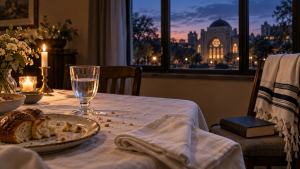
Every Shabbat meal, we wash our hands and recite a blessing on two loaves of bread (known as challah). Why do we have double loaves? We do this to remember the double portion of manna that fell in the desert every Friday: during the week only one portion fell, but on Friday, each person got a double portion, one to be eaten on that day and one to be saved for Shabbat.
Challah Covering
While we recite the Friday night Kiddush, we make sure to cover the challot with a challah cover. We do this for three reasons.
- Usually, when someone has both wine (or grape juice) and bread, the blessing over bread comes first, but on Shabbat we make Kiddush and the blessing on wine is first. Therefore, we cover the challah so it shouldn’t “see” that it is being skipped over and feel slighted. This teaches us that if we are considerate towards the challah’s ‘feelings’ how much more so should we be careful with people’s feelings!
- The second reason we cover the challot is to remember the manna we ate in the desert for 40 years, which was blanketed on top and below with dew.
- The third reason is to make it obvious that the bread, which is the staple of the meal, is there in honor of Shabbos.1 Therefore it’s only revealed at the start of the seudah (meal) after kiddush.
At Shalosh Seudot (the third meal), where we don’t make Kiddush, only the second reason applies and there are different customs whether one covers the challah then.
The Best Shabbat
The Torah uses two words when it speaks about the mitzvah of Shabbat – “Zachor” and “Shamor”. This double language is why we use two whole loaves each meal, called lechem mishnah.2
If one person is making hamotzi for a crowd, only one lechem mishnah (double bread) is needed and everyone is given a piece of challah from the “main loaves”, instead of each individual having their own two loaves.3
There is a custom dating back to the time of the Gemara to make fresh homemade challah for Shabbat. This is to honor Shabbat by having delicious food ready. Another reason is so we can do the mitzvah of hafrashat challah.4
Many families will purchase their challot from a bakery and there is nothing wrong with that at all! One just needs to make sure that the store they purchase from already did the hafrashat challah.
Very Holy
Rabbi Shamshon Raphael Hirsch describes bread as the essence of gashmiyut (physicality) since it forms the basic nourishment that sustains the human body. By separating challah, we elevate that physicality, turning the act of eating into something kadosh (holy). This small act symbolizes the eternal mission of mankind, to uplift the body and use it in the service of the neshamah (soul). Hafrashat challah becomes a declaration that even the most physical aspects of life can, and must be sanctified. Similarly, on Shabbat, when the very purpose of the meal is to use the body to elevate the soul, and in turn, let the soul elevate the body.
A Deeper Dig
Wherever Jews gather to celebrate Shabbat, you’ll always find two loaves of bread at the Shabbat table. Lechem Mishnah has become an enduring symbol of Shabbat, and is one of those iconic rituals that transcends time and geography, binding generations and communities together in a shared expression of faith. Children grow up expecting it, and adults instinctively lift both loaves when reciting the hamotzi blessing. Where is this tradition coming from?
The act of placing two loaves on the table each Shabbat connects us directly to the manna, the miraculous sustenance that the Jewish people in the wilderness ate. This miracle, described in Parshat Beshalach, teaches us about Divine Providence, bitachon (reliance) in Hashem, and the centrality of Shabbat itself.
Like The Manna
While the manna was already a nature-defying wonder, the double portion that fell every Erev Shabbat (Friday) revealed an even deeper layer of divine intention. The Torah recounts how on the sixth day of the week, the people discovered that a double portion of manna had fallen. Startled and amazed, the elders of the nation ran to Moshe Rabbeinu to share what they believed was astonishing, brand-new information. But to their surprise, Moshe already knew.
Their reaction reveals something remarkable. Moshe had been informed in advance by Hashem about the double portion, yet he had chosen not to share this detail with the people beforehand. This leads to a powerful question. If Moshe already knew, why had he kept this knowledge to himself? Why had he allowed the people to be surprised by the miracle rather than prepare them for it in advance?
Surprise!
The Or HaChaim addresses this, explaining that although Hashem had revealed the miracle to Moshe, He had not commanded him to relay it to the people. The Torah uses the phrase “Hu asher diber Hashem” – “This is what Hashem spoke,” without the word “laymor”, which usually accompanies a directive to speak to the nation. In the absence of that command, Moshe remained silent. Why would Hashem intentionally withhold this information from Bnei Yisrael (the sons of Israel)? The answer uncovers a profound lesson about the nature of Shabbat and how Hashem chooses to reveal Himself.
The mitzvah of Shabbat is k’neged kol haTorah kulah, equal to the entire Torah in significance. Because of its supreme importance, Hashem wanted the people to experience the miracle of the double portion, not expect it. Had they been told in advance, they would have approached it with anticipation but not wonder. By discovering it unexpectedly, the moment landed with far more emotional and spiritual impact. This divine strategy turned a logistical convenience into a transformative spiritual moment. It trained Bnei Yisrael to become attuned to Hashem’s Hand in their lives, to recognize that Shabbat comes with a special measure of care and blessing.
As We Have It Today
Fast forward thousands of years, and we still commemorate this miracle with our Lechem Mishnah. At each Shabbat meal, we place two loaves of challah on the table and lift them together for the blessing of hamotzi, a gesture that carries the weight of Jewish history and Divine love. These loaves are an echo of the Jewish people’s total reliance on Hashem, a reminder of the double manna, and a weekly testimony to Hashem’s ability to sustain the world constantly.
Lechem Mishnah is a mitzvah (commandment) that urges us to connect our physical world with spiritual awareness. It is a chance to reflect on Hashem’s care, the rhythm of preparation and rest, and the eternal bond between the Jewish people and Shabbat. It reminds us that Shabbat
was never just about stopping work, but is about entering a different dimension of trust, serenity, and connection.
Think About It
However, for many, the practice has become mechanical. Two challahs are placed on the table, the blessing is recited, and the meal begins. But if we pause during that moment of blessing, and we take even a few seconds to reflect on that beautiful miracle of the double portion in the wilderness, we transform a simple ritual into a rich jewel of spiritual experience.
Shabbat Shalom!
Excerpted from Oorah’s Torah Nuggets
Shabbat Meals Part 5 – Sources:
1 Tur 271
2 Shabbos 117b; Shulchan Aruch 274:1; Aruch
Hashulchan 2
3 Mishnah Berurah 274:8 and 167:83
4 Magen Avraham 242:4